
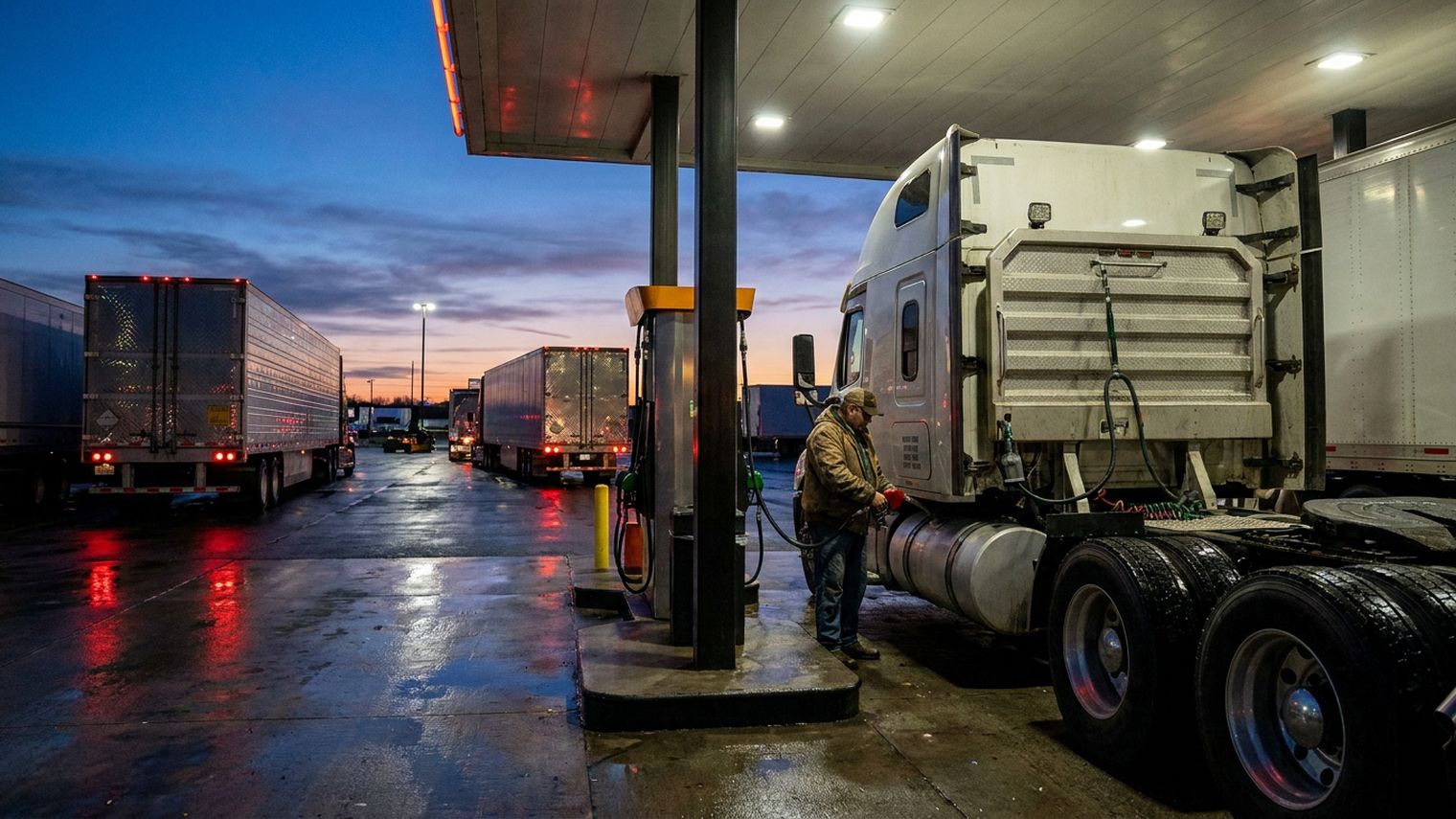
AAA's national average for on-highway diesel reached $5.9015 a gallon on Sept. 7, the highest price ever recorded and the second time the record has fallen in four days. Diesel is up roughly 30 cents from a week ago, 57 cents from a month ago, and $2.19 from September 2025 — a 59% increase in the largest variable cost most carriers carry.
This is a supply story, not a demand story. Six months of war with Iran have pulled refined product out of the market, and the pump has followed.
The spread is the tell
The previous record of $5.8159 had stood since June 2022 until it fell on Sept. 4, when the average hit $5.85. Regular gasoline that day averaged $4.1474 against $3.2016 a year earlier — up 30%, about half the rate diesel has climbed. Distillate, not gasoline, is where the shortage sits, and distillate is what moves freight.
Downstream, the cost is already repricing. Amazon has added a temporary 3.5% fuel and logistics fee on third-party sellers, and UPS, FedEx and USPS have layered on package surcharges. Contract freight reprices on a lag, so the carriers with the least pricing power — owner-operators and small fleets running spot — absorb the difference first and longest.
The cost-per-mile math has moved under you
ATRI's latest Analysis of the Operational Costs of Trucking put fuel at 48 cents a mile and total marginal cost at $2.33, with maintenance and repair up 8.6% year over year and tires up 6.4%. That report measured 2025, when diesel spent the year under $4. Every fuel line in a budget built on it is now wrong in the same direction.
Run the arithmetic at today's price. A tractor turning 6.5 mpg burns about 91 cents a mile in fuel; at 6.0 mpg it burns about 98 cents. That half-mpg gap is worth roughly $7,600 per 100,000 miles — more than most of the repairs that would close it. At last September's $3.71 the same gap was worth about $4,700, which is why deferring those repairs used to pencil out and no longer does.
What to check before the next fill
The mechanical causes of lost fuel economy are unglamorous and cheap to find. Tire pressure at every position, air and fuel filter intervals that slipped during the freight downturn, drive axle alignment, brakes that drag. Then pull regen frequency by unit: a truck running active regenerations far more often than its stablemates is telling you something — a loaded DPF, an EGR cooler on the way out, a lazy NOx sensor — and it is burning fuel to say it. If you are working back from a symptom rather than a fault code, the free diagnostic guides beat swapping parts in sequence.
Idle is the other line. Argonne estimates that more than a million long-haul trucks idle through federally required rest periods every day; at $5.90 the payback window on an APU, a bunk heater or a coolant heater is shorter than whatever spreadsheet you built last year. Before ordering, confirm what the model years in your fleet will actually take — spec and fitment data by make and model will tell you.
And when the dealer quotes that filter, sensor or aftertreatment component, run the OEM number through a free interchange lookup before you pay it. With fuel taking this much of the mile, the parts line is the one place left with any give in it.

Find the right part for your truck
Tell PartsNow AI the truck and the job. It checks fitment, finds OEM cross-references and pulls live pricing from the catalog.
PartsNow Newsroom
Parts news, straight to your inbox
Product updates, catalog additions and new cross-references. Unsubscribe anytime.