
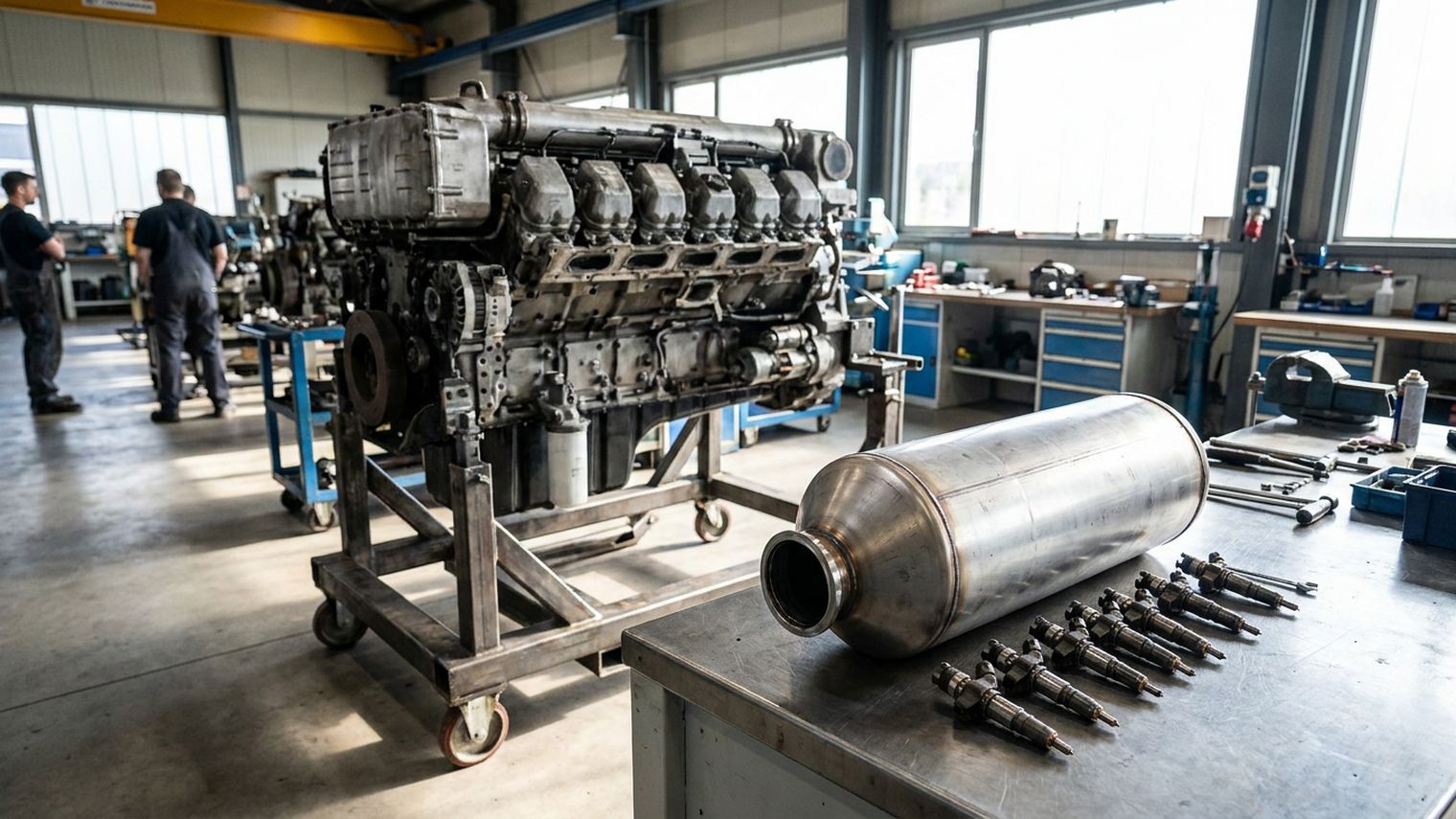
Daimler Truck North America opens the order book Tuesday for the Detroit Gen 6 DD13 and DD15, the first Detroit engines built to the EPA's 2027 nitrogen oxide limit. The rule drops allowable NOx to 35 milligrams per horsepower-hour from 200 and takes effect Jan. 1. Engines start reaching customers in January 2027, with the DD16 following in January 2028.
What makes the launch worth a fleet's attention is what Detroit left off the engine. The company skipped the 48-volt electrically heated aftertreatment that some of its peers adopted to hit the same number. "We don't need the 48-volt system, which means the incremental cost increase is not that high," Daimler Truck CEO Karin Radstrom said.
An evolution, not a clean sheet
About 75% of the Gen 6's core components carry over from the current generation, DTNA says. The emissions work is handled by a pre-SCR unit sitting upstream of the main aftertreatment, built from what Detroit calls familiar elements of the existing SCR system, plus a thermal control valve that uses exhaust heat to bring the aftertreatment up to temperature faster. Detroit says the combination cuts the need for parked regenerations, and the whole stack fits existing chassis space without growing behind the cab.
The engine gets a simplified fuel system that drops the amplified injection requirement, new injectors for better fuel and air mixing, camshaft Miller timing, and an asymmetric intake port for more swirl. Torque tops out at 1,900 lb-ft. DTNA claims roughly 3% better driving fuel efficiency for a typical linehaul fleet, after three years and more than 8 million validation miles.
The quarter that changed is the expensive quarter
Seventy-five percent carryover is real news for anyone who stocks a shelf: filters, gaskets, pumps and most of the rotating assembly should keep their existing part numbers and their existing aftermarket. The 25% that changed is concentrated at the costly end — the injectors, the fuel system and the pre-SCR canister. Those are new part numbers with no interchange history, and for the first several years they will be dealer-only. Budget them at OEM list, not at the aftermarket price you are used to paying on a Gen 5 DD15.
Dropping the 48-volt heater removes a whole parts and tooling category that competing 2027 engines will carry: no high-voltage heater element in the aftertreatment stack, no 48-volt harness or converter to diagnose, no high-voltage service qualification for the technician who works on it. For a small shop, that is a real number.
DTNA is also discontinuing its current-standard engines rather than selling both lines, so 2026 builds are the last Gen 5 Detroits. Whatever leaves the line this year sets your parts baseline for the next decade.
What to settle before you spec a 2027 truck
If you are weighing a 2026 pre-buy against stepping straight into Gen 6, do the parts math and not just the truck price. Confirm which engine generation a given Cascadia or Western Star build actually carries before you sign — the model-year specs for each make are the quickest way to check what you are committing to.
For the Gen 5 DD13s and DD15s you plan to keep, this is the year to price the wear items you will need through the 2030s while a competitive aftermarket still exists: DPF, DOC, SCR catalyst, DEF doser and pump, and injectors. Supersessions come thick and fast on aftertreatment hardware, so verify the interchange on the part number before you commit to a pallet of anything.
And clear the DEF and regen faults you have been carrying. A truck already forcing parked regens or throwing derate codes is a poor trade-in and a worse baseline for a spec decision — work the symptom back to the failed component while it is still a shop visit and not a tow.

Find the right part for your truck
Tell Mike the truck and the job. He checks fitment, finds OEM cross-references and pulls live pricing from the catalog.
PartsNow Newsroom
Parts news, straight to your inbox
Product updates, catalog additions and new cross-references. Unsubscribe anytime.