
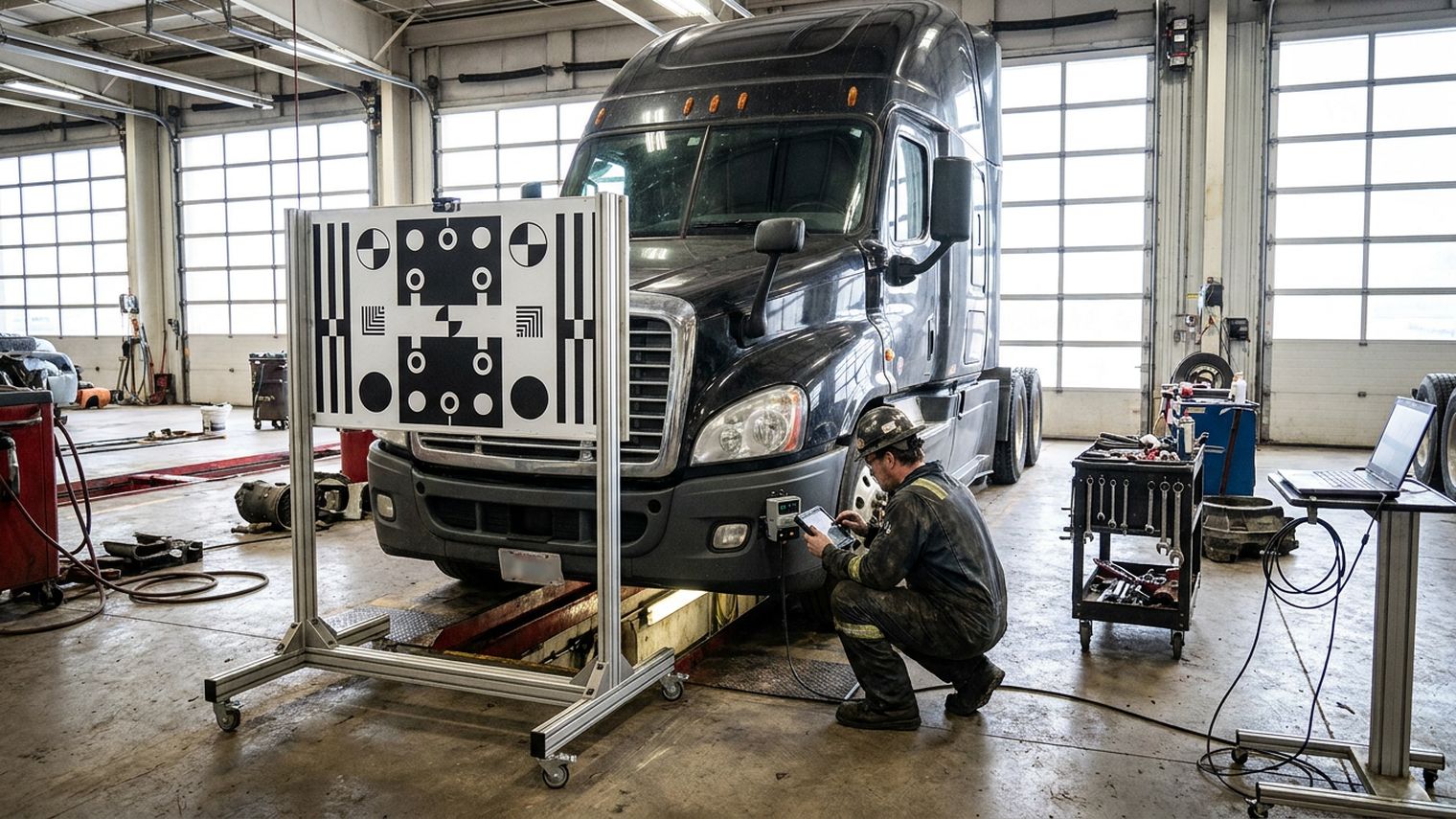
A white paper released Aug. 31 by Autel North America argues that commercial truck shops are guessing far too often about when an advanced driver assistance system needs to be recalibrated, and proposes a blunt fix: make the repair itself the trigger, rather than leaving it to a technician's judgment about whether the repair mattered enough.
That argument lands as forward radar and windshield-mounted cameras become standard content on new Class 8 tractors, and as jobs nobody used to think of as electronics work — an alignment, a glass replacement, a bumper swap — quietly change where a sensor is pointed.
The proposed trigger list
Titled "Closing the OEM Procedure Gap in ADAS Calibration," the paper by Autel North America senior executive Stew Peregrine asks that calibration requirements be made "explicit, event-based and easier to identify." The events it names are everyday ones: wheel alignments, steering and suspension adjustments, ride height changes, collision damage affecting mounting areas, sensor removal or replacement, glass replacement, bumper replacement, body repair and sublet operations.
The sharpest line in it is about alignment. After any wheel alignment, the paper says, all forward-facing ADAS calibrations should be performed — the shop should not be deciding whether the adjustment was big enough to matter. "When alignment values change, the vehicle's geometric truth changes," Peregrine writes. He also wants physical aiming angles and vehicle geometry verified against manufacturer specs before anyone runs a digital calibration, on the grounds that "digital calibration cannot compensate for unknown or incorrect physical geometry."
Where current guidance stops short
Nothing in today's commercial-vehicle guidance goes that far. The Technology & Maintenance Council's RP 548 sets out training guidelines for diesel technicians and other repair personnel — alignment and tire technicians explicitly included — who work on ADAS-equipped trucks, and points them back to current OEM or supplier procedures rather than a single universal rule.
Those supplier procedures already reach further than most shops assume. As Fleet Equipment reported in its review of the manuals, ZF's OnGuardMAX documentation calls for service alignment after work affecting tires, chassis, windshields, camera or radar sensors, or front body components, and Bendix service information treats radar alignment as critical, with realignment or outright replacement possible after a collision. Bendix also notes that Wingman Fusion implementations vary by truck manufacturer — which is precisely why one blanket procedure is hard to write. The blanket alignment trigger remains an industry position, not a requirement.
What to check before the truck leaves the bay
The exposure is in work already on your schedule. Any tractor going on the alignment rack, taking a new windshield, or getting bumper or fascia work after a light collision should be treated as an ADAS job as well as a chassis job: identify the installed system, pull a pre-scan, then follow the OEM or supplier procedure for that truck.
Identification is the step fleets skip, and it is not obvious from the badge — the same model can ship different radar and camera hardware across model years and option packages, so confirm what your make and model year actually came with before you quote the repair. If a radar, camera bracket or mounting hardware has to be replaced rather than realigned, check the interchange on that part number before ordering; ADAS components carry OEM-level pricing and supersessions move quickly on hardware this new.
And if a truck is throwing an ADAS fault after routine service rather than after a crash, work the symptom before you buy anything — the free diagnostic guides cover sensor and electrical failure modes, and a radar that was simply knocked out of aim does not need a new sensor. Budget the labor hour for calibration into alignment and glass work now, because the procedure is not going to get shorter.
Find the right part for your truck
Tell PartsNow AI the truck and the job. It checks fitment, finds OEM cross-references and pulls live pricing from the catalog.
PartsNow Newsroom
Parts news, straight to your inbox
Product updates, catalog additions and new cross-references. Unsubscribe anytime.