
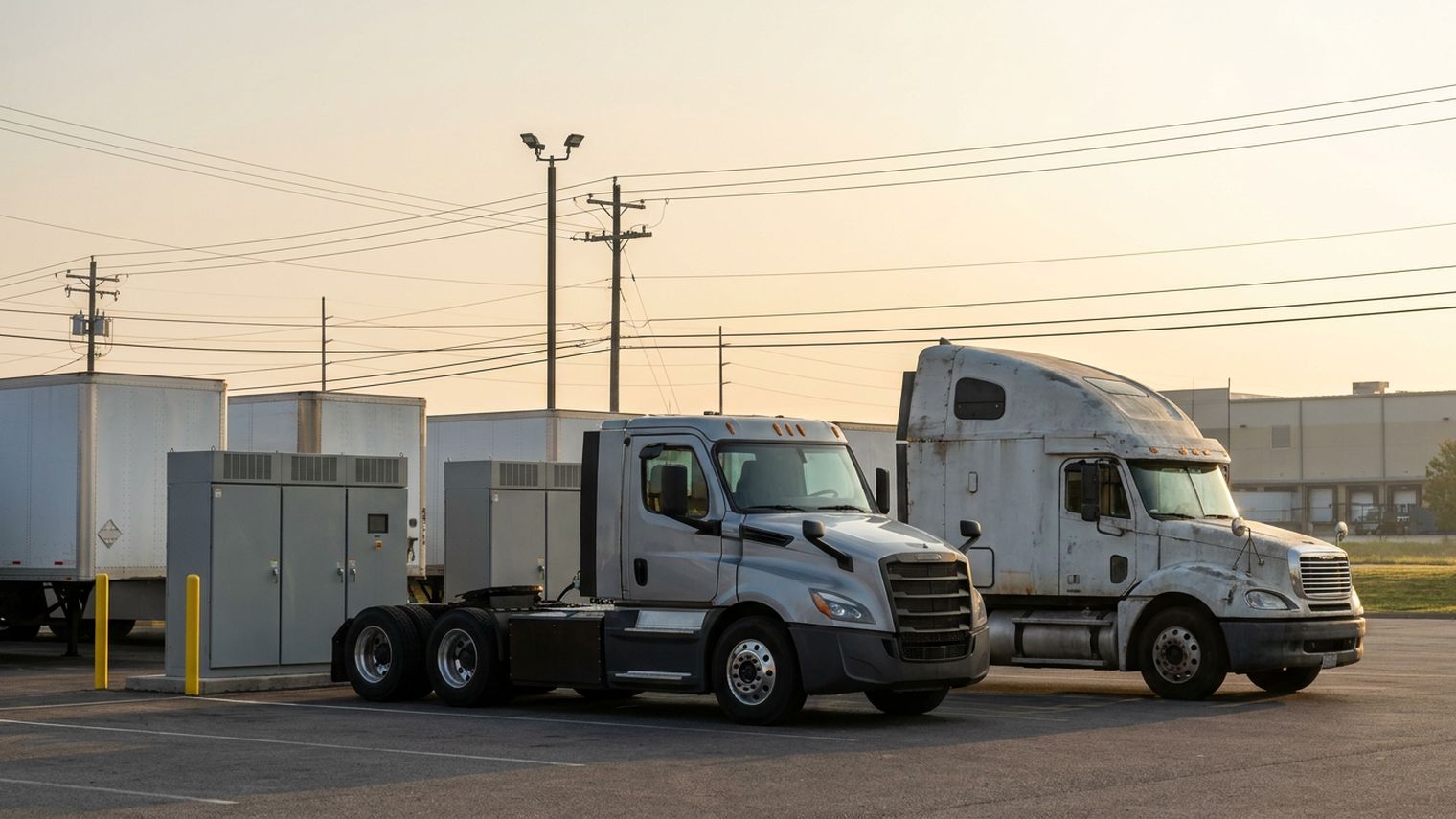
California Gov. Gavin Newsom signed SB 1213 on Sept. 20, making a published price the condition of state money for zero-emission trucks. Beginning Jan. 1, 2027, any manufacturer that wants its medium- and heavy-duty ZEVs to stay eligible for California incentives must file a suggested retail price with the state, along with final purchase order data for each vehicle sold.
The California Air Resources Board, working with the California Energy Commission, will compile that data and publish it every six months. An OEM that does not file can have its models suspended from the incentive list, and the state can refer suspected false data or anticompetitive pricing to the attorney general and recover funds already paid out.
The gap that prompted it
The bill traces to a pricing divergence fleets have complained about for years and that researchers finally put a number on. An ICCT analysis of battery-electric commercial vehicle pricing found the median US battery-electric Class 8 tractor rose 27%, or $87,100, between model year 2020 and model year 2025. Over the same stretch the median price of a comparable tractor in the European Union fell 32%, even as lithium-ion pack costs dropped in both markets.
At model year 2025 the median US battery-electric Class 8 tractor listed at $411,200 against $172,500 for the diesel equivalent. That $238,700 spread is what a voucher has to close before a fleet can pencil the trade, and until now nobody outside the OEM could see which side of it the voucher actually landed on.
What changes at the order desk
State Sen. Eloise Gómez Reyes, who wrote the bill, said the requirement would bring "clarity and accountability to the clean truck market" and help "drive those costs down over time," Transport Topics reported after the signing. The mechanism is straightforward: when incentive programs pay out against a price nobody publishes, there is no way to tell whether a voucher lowered a fleet's cost or was absorbed into the sticker. A public price table, refreshed twice a year, gives buyers a reference point — and gives competing OEMs one too.
The requirement reaches past the state's own buyers. The measure cleared the legislature last month, with the Assembly agreeing to Senate amendments, and once CARB begins publishing, any fleet can pull the table and quote against it — whether or not it is buying in California.
What fleets should check before the first tables post
If you have a 2027 ZEV order moving under a California program, the useful move this quarter is to lock the configuration but not the price — get the quote in writing now so you can set it against CARB's first published table and reopen the conversation if the two do not line up.
For mixed fleets, the more durable work is on the parts side of the total-cost math, which is usually the thinnest part of any electric-versus-diesel comparison. A battery-electric tractor deletes the entire aftertreatment line — DPF, DOC, SCR catalyst and DEF dosing hardware — along with engine oil, fuel and coolant filtration. Very little else goes away. Steer and drive axle brakes, air system components, kingpins, suspension, lighting, mirrors, HVAC and tires sit on the same chassis at the same service intervals, and on a platform built in both drivetrains a good number of them carry identical part numbers. Before assuming a BEV spec rewrites your parts budget, compare the specs and fitment for the two variants of the model you run and run the shared chassis numbers through an interchange check. The carryover is usually wider than the sales deck implies, and it is the one line of the TCO case you can verify for yourself.

Find the right part for your truck
Tell PartsNow AI the truck and the job. It checks fitment, finds OEM cross-references and pulls live pricing from the catalog.
PartsNow Newsroom
Parts news, straight to your inbox
Product updates, catalog additions and new cross-references. Unsubscribe anytime.