
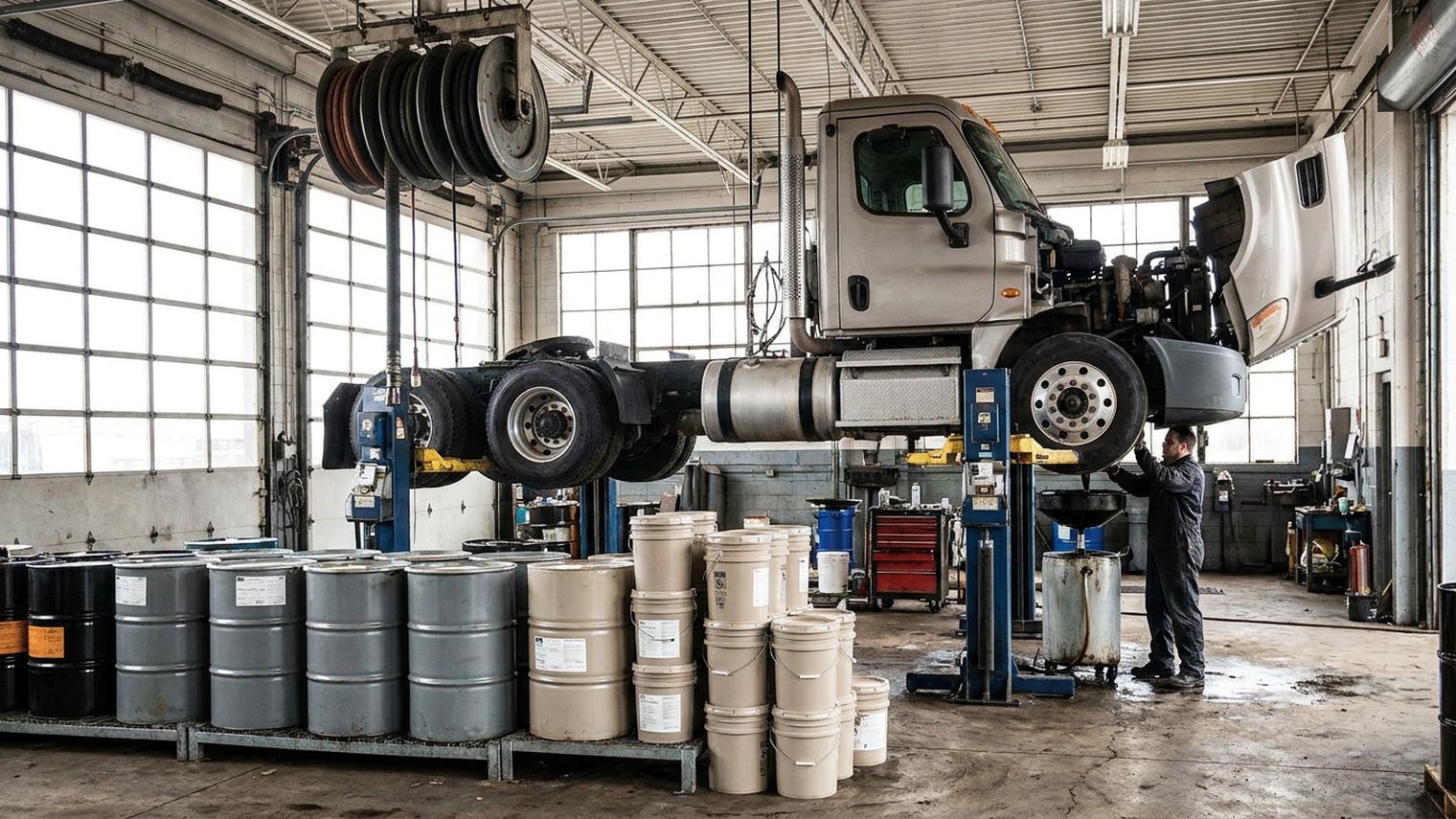
Costco has nearly doubled the price of its Kirkland Signature full-synthetic motor oil and capped how much a member can carry out in a week — two boxes of the house brand, five six-packs of Mobil 1. Rationing at a warehouse club is a consumer story. The reason behind it is not. The base stock that makes up most of the volume in every drum of diesel engine oil in your shop has been repriced, and the heavy-duty market draws on the same barrels.
Federal price data says that repricing has already reached the invoice. It also says the worst of it has not landed yet.
What broke upstream
The squeeze is in base oil, not blending capacity. Group III stock that changed hands at $3.40 a gallon in January was going for $11.40 by July, a 235% move, according to trade reporting on the Gulf supply disruption. Shell's Pearl GTL plant in Qatar lost roughly half its capacity after two trains at Ras Laffan were destroyed, and cargoes that moved from Saudi Arabia to the UAE in about ten days now route around the Cape of Good Hope and take ten weeks. Petrolube Group CEO Salman Saadat told that report "the constraint is not confined to Group III — Group II is affected too." That matters here: Group II is the workhorse stock behind conventional and synthetic-blend CK-4 diesel oils.
Crude is compounding it. EIA spot data puts Brent at $109.51 on Sept. 9, against $68.53 on July 2. Refiners facing that spread send barrels toward diesel and gasoline before base oil — the dynamic cited in reporting on the retail price move.
The index that hasn't caught up
Strip out the retail anecdote and the federal series tells a cleaner story. The Bureau of Labor Statistics producer price index for finished lubricants closed August 2026 at 695.984, against 605.624 in August 2025 — up 14.9% year over year. The comparable move the year before was slightly negative. This is a 2026 event, start to finish.
The detail worth pinning up in the shop is the last two prints: July 696.580, August 695.984 — flat. That plateau is not relief. It reflects barrels bought before Brent ran from roughly $90 in late August to $109.51, and before the early-September disruptions. September and October are where that shows up, and blenders buy base stock weeks ahead of the drums they ship.
What fleets should check before the next PM cycle
Pull your bulk oil agreement and find out whether it is fixed with an expiry date or carries a base-oil escalator. If it is fixed, you know how long the cushion lasts; if it floats, budget next quarter off replacement cost, not your last invoice.
The tempting response — stretching drain intervals — is the one to be careful with. Extend on used-oil analysis, not on the price of a drum, and not past the OEM interval without confirming the filtration is rated for it. Higher-capacity or bypass oil filters are a cheaper hedge than soot-loaded oil and a spun bearing.
Verify the grade you are ordering, too. FA-4 low-viscosity oils are approved only for specific newer engines and are not a drop-in for every CK-4 application; the split runs by engine family and model year, not by nameplate, so confirm which engines your model years were built with before anyone swaps a grade to save a few dollars a gallon.
Finally, expect substitutions at the counter. When your usual oil filter number is on backorder and a distributor offers something else, check the interchange on that part number first. Filter media, bypass valve settings and thread pitch vary across numbers that look close enough on a shelf tag.

Find the right part for your truck
Tell PartsNow AI the truck and the job. It checks fitment, finds OEM cross-references and pulls live pricing from the catalog.
PartsNow Newsroom
Parts news, straight to your inbox
Product updates, catalog additions and new cross-references. Unsubscribe anytime.