
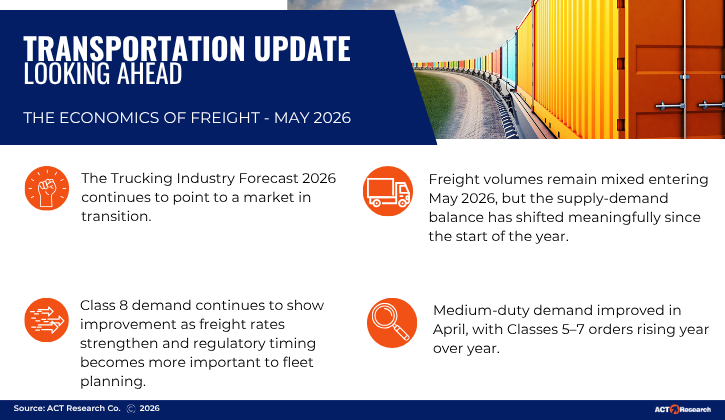
The U.S. trucking market moved closer to equilibrium in June as freight volumes cooled and carriers added capacity, even as spot rates kept retreating into late July. According to Truck News, citing data from ACT Research, June brought a close balance between supply and demand, with easing volumes on one side and rising capacity on the other.
ACT's For-Hire Trucking Volume Index slipped to 65.9 from May's cycle high, while its Capacity Index climbed to 55, the highest reading in 43 months. The net effect pulled the Supply-Demand Balance Index down to 60.9 from 64.2 in May. ACT analyst Carter Vieth noted that industrial demand continues to draw strength from data center construction, and that lower energy prices and reduced tariffs should support retail restocking in the months ahead, with vocational and flatbed among the strongest segments.
Spot rates fall even as diesel jumps
The near-term picture is softer. U.S. spot truckload rates dropped 2.5% week over week to $3.38 per mile in the week ended July 24, per Truckstop data reported by Truck News, even as the national average diesel price spiked 27 cents to $5.13 per gallon. Dry van, refrigerated, and flatbed rates all fell. Truckstop pointed out that July is typically a weak month for spot rates, and that this particular decline was the steepest for that week of the year since 2022.
That seasonal dip sits inside a stronger year-over-year story. Truckstop's Market Demand Index, though down sharply on the week, remained more than 70% above the same week last year. Broader market trackers echo the same split-screen: earlier in the summer, FTR recorded dry van spot rates hitting an all-time high in the pre-July 4th week before pulling back, a swing consistent with the holiday-driven volatility analysts had flagged.
The bigger trend: a tightening market
Zoom out, and 2026 has been a recovery year for freight fundamentals. ACT Research reports that spot activity has held above prior-year levels, rate conditions have improved, and contract pricing is starting to respond as capacity tightens, driven as much by reduced supply as by demand. A June State of Transportation report compiled by FreightWaves for Ryder found that spot rates had risen above contract rates for the first time in several years, tender rejections had topped 15%, and smaller carriers were continuing to exit the market.
Capacity remains the structural constraint. Vieth noted that Class 8 truck sales are running below replacement levels, and expects capacity growth to accelerate later in the year as stronger spot rates feed into contract pricing and fleets begin replacing aging equipment ahead of EPA 2027 emissions rules.
What it means for fleets and the parts chain
For carriers, the message is mixed but tilting positive: near-term spot softness is largely seasonal, while the underlying trend points to firmer rates and tighter capacity into 2027. Fleets that hold older trucks in service longer to stretch capacity will lean harder on maintenance and replacement parts to keep those units earning. At PartsNow, that's the shift we watch most closely, because when equipment has to run longer and harder, fast, reliable parts sourcing becomes part of the margin.
Sources: Truck News, ACT Research, FTR, Ryder / FreightWaves.

Find the right part for your truck
Tell PartsNow AI the truck and the job. It checks fitment, finds OEM cross-references and pulls live pricing from the catalog.
PartsNow Newsroom
Parts news, straight to your inbox
Product updates, catalog additions and new cross-references. Unsubscribe anytime.