
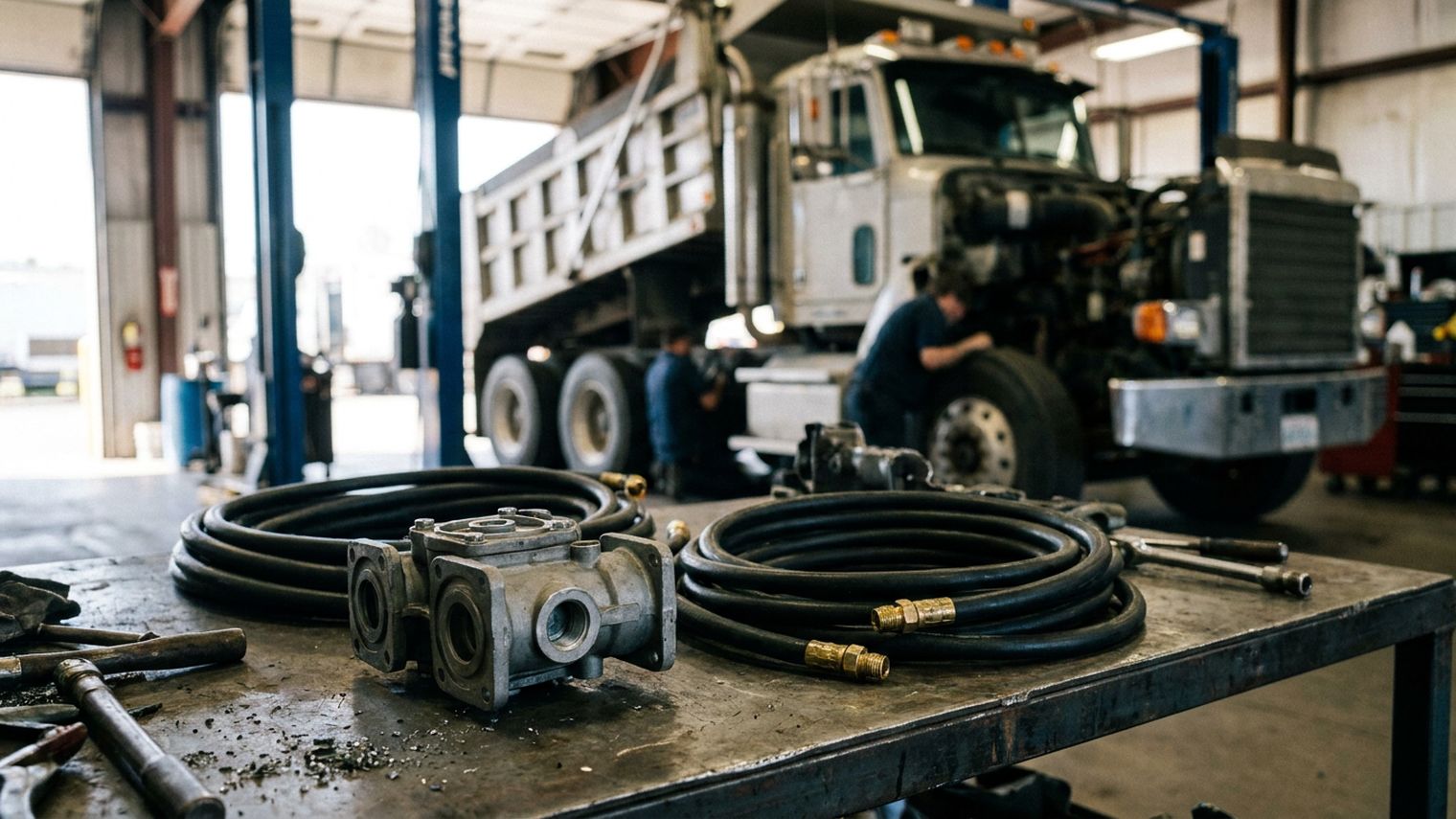
PACCAR filed a noncompliance report with federal safety regulators on Sept. 1 covering 58 model year 2027 Peterbilt 548 vocational trucks built with the wrong front brake valve and the wrong air hoses. The trucks stop. They just take too long doing it.
Fifty-eight units is a rounding error beside the six-figure passenger-vehicle campaigns filed the same week. The defect behind it is not. On an air-braked truck the plumbing is a timing device, and a part that threads into the port is not the same as a part that is correct.
What PACCAR reported
Campaign 26V-567, carried under PACCAR's number 26PACF, states that the front brake valve and hoses "may be the incorrect size, which can delay the rear service brake application and release, as well as the trailer gladhand application times." NHTSA codes the component as a proportioning relay valve in the air service brake controls and finds the trucks noncompliant with Federal Motor Vehicle Safety Standard 121, "Air Brake Systems." The consequence is stated plainly: delayed brake response increases crash risk.
The remedy is a parts swap. Dealers will replace the front brake valves and hoses free of charge, with owner letters mailing Oct. 31. Peterbilt customer service is 940-591-4220.
The model matters here. The 548 is Peterbilt's Class 8 vocational conventional, rated to 66,000 pounds GVWR on up to 20,000-pound front and 46,000-pound rear axles, and sold into plow, crane, bucket, dump and refuse work — heavy trucks in stop-and-go duty, frequently loaded and frequently towing.
Half a second is the entire margin
FMVSS 121 leaves little room. From 100 psi in the service reservoir, brake chamber pressure on a truck must reach 60 psi in not more than 0.45 second. On release, from 95 psi in the chamber, it must fall to 5 psi within 0.55 second. On a truck built to pull an air-braked trailer, the test reservoir at the service gladhand must reach 60 psi no later than the fastest chamber on the truck — or within 0.35 second, at the manufacturer's option.
Those windows are set almost entirely by hardware dimensions: valve port and orifice size, hose inner diameter and length, crack pressure. None of it is visible, and none of it shows up in a pre-trip air test. The system builds, holds and applies normally. It just does all of it late, and the trailer behind it gets its signal later still.
That is why this campaign is worth more than its unit count. If a wrong-size valve and hose combination cleared an OEM assembly line working from an engineering parts list, the odds are worse in a shop matching a replacement to the old part by eye.
What to check before the next brake job
If you run 2027 Peterbilt 548s, run the VINs now instead of waiting for the Oct. 31 letter. The fix is free, and it is a physical part replacement rather than a software flash.
The wider job is your own repair history. Any truck that has had a front brake valve, a relay or quick-release valve, or an air line replaced outside the OEM parts list carries the same risk this recall describes. Ask what part number actually went on. A hose one size down in inner diameter, or a foot longer than spec to make routing easier, changes application time. So does a relay valve with a different crack pressure.
When you source a substitute for an air brake valve or hose, verify the interchange against the OEM number rather than trusting a visual match, and confirm that number is right for that make, model and model year — vocational chassis change plumbing specs between build years more often than fleets expect. If a truck already shows symptoms — slow release, rear brakes dragging, a trailer that grabs late — work the failure modes before swapping parts.

Find the right part for your truck
Tell PartsNow AI the truck and the job. It checks fitment, finds OEM cross-references and pulls live pricing from the catalog.
PartsNow Newsroom
Parts news, straight to your inbox
Product updates, catalog additions and new cross-references. Unsubscribe anytime.