
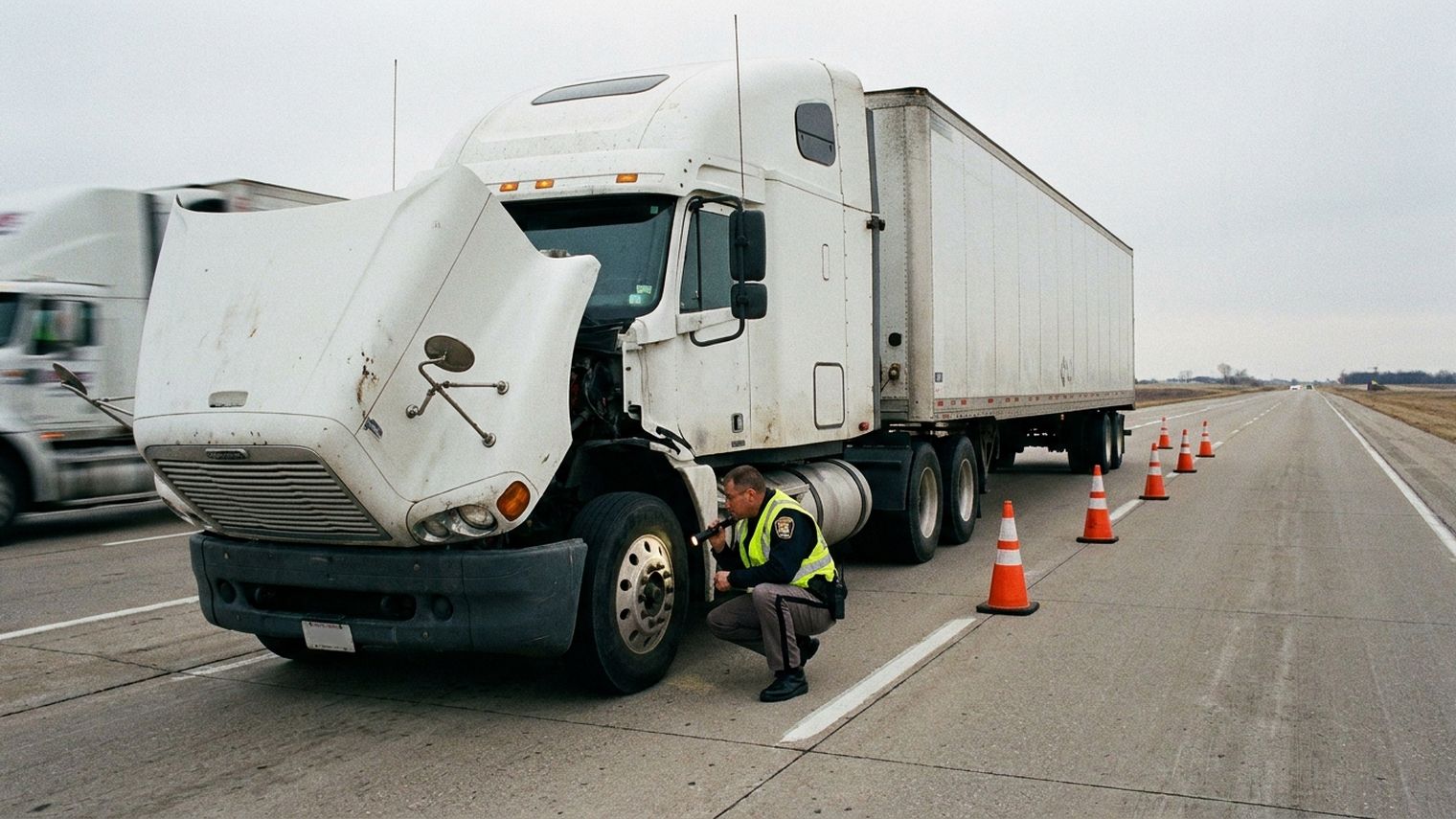
WASHINGTON — Federal inspectors made 3,487 roadside enforcement stops over three days in late July and placed 766 commercial vehicles and drivers out of service, the second and broadest wave of a joint Department of Homeland Security and Department of Transportation campaign called Operation Highway Shield.
The July 28-30 sweep moved the program off its original Florida footprint and onto Midwest freight corridors in Illinois, Indiana, Iowa and Ohio, with ICE's Homeland Security Investigations working alongside FMCSA and state highway patrols. Trade coverage put the combined driver and vehicle removals at roughly 800, the figure federal officials have used publicly.
One in five stops ended in a shutdown
The number that matters to anyone running equipment is 766 out of 3,487 — roughly 22% of stops ended with a truck or a driver shut down at the roadside. Immigration enforcement drew the coverage but was the smaller share of the total: 51 detentions, including 21 drivers holding non-domiciled CDLs issued by California and New York. The operation also produced 47 criminal charges, 39 incarcerations, 36 English language proficiency violations and three cargo theft recoveries worth about $1 million.
Federal officials have not released a violation-by-violation breakdown of the 766, so any brake-versus-lighting split is guesswork. What is not guesswork is what an out-of-service order costs.
The math on a roadside shutdown
An OOS order does not end with a citation. The truck stays where it sits until the defect is repaired and re-inspected — a service call at highway rates, a load that misses its appointment, and a violation that rides on the carrier's CSA record for two years. For a single-truck operation, one afternoon on the shoulder can erase the margin on the run.
That is the case for spending on the pre-trip instead of the repair. Brakes, lighting, tires and coupling devices are the categories that most often strand a truck at a roadside inspection, and every one of them is cheap to check and comparatively cheap to fix in a shop. Fleets working the I-80, I-70 and I-65 corridors through the four target states should assume inspection pressure stays elevated and carry the fast-moving wear items — air brake chambers, slack adjusters, lamps and air lines are what turn a two-day roadside problem into a two-hour one.
English proficiency is now a roadside standard
Thirty-six ELP violations is small in absolute terms, but the significance is that the standard is being enforced at the roadside rather than at the licensing counter. FMCSA Administrator Derek Barrs framed it as an existing safety rule rather than a new one: "It's been the law for a long period of time. It's a safety issue," he said, adding that in an emergency "I would want to make sure that driver would know how to respond — slow down for upcoming traffic or a crash that has happened up ahead."
For carriers, that exposure sits in the hiring file, not in the truck. A driver who cannot read highway signage or answer an inspector's questions is an out-of-service risk on every run.
What to watch next
Highway Shield has now run in Florida and across four Midwest states, and the structure — federal immigration agents paired with FMCSA inspectors — is the part most likely to repeat. The second-order effect is capacity: pulling drivers and equipment out of a market that has only recently begun to tighten adds upward pressure on spot rates in precisely the lanes the sweeps target.
Two things worth tracking: whether a third wave lands in another corridor, and whether FMCSA publishes the defect breakdown behind those 766 orders. Without it, fleets are guessing at which components inspectors are actually writing up — and stocking the parts shelf on instinct rather than data.

Find the right part for your truck
Tell PartsNow AI the truck and the job. It checks fitment, finds OEM cross-references and pulls live pricing from the catalog.
PartsNow Newsroom
Parts news, straight to your inbox
Product updates, catalog additions and new cross-references. Unsubscribe anytime.