
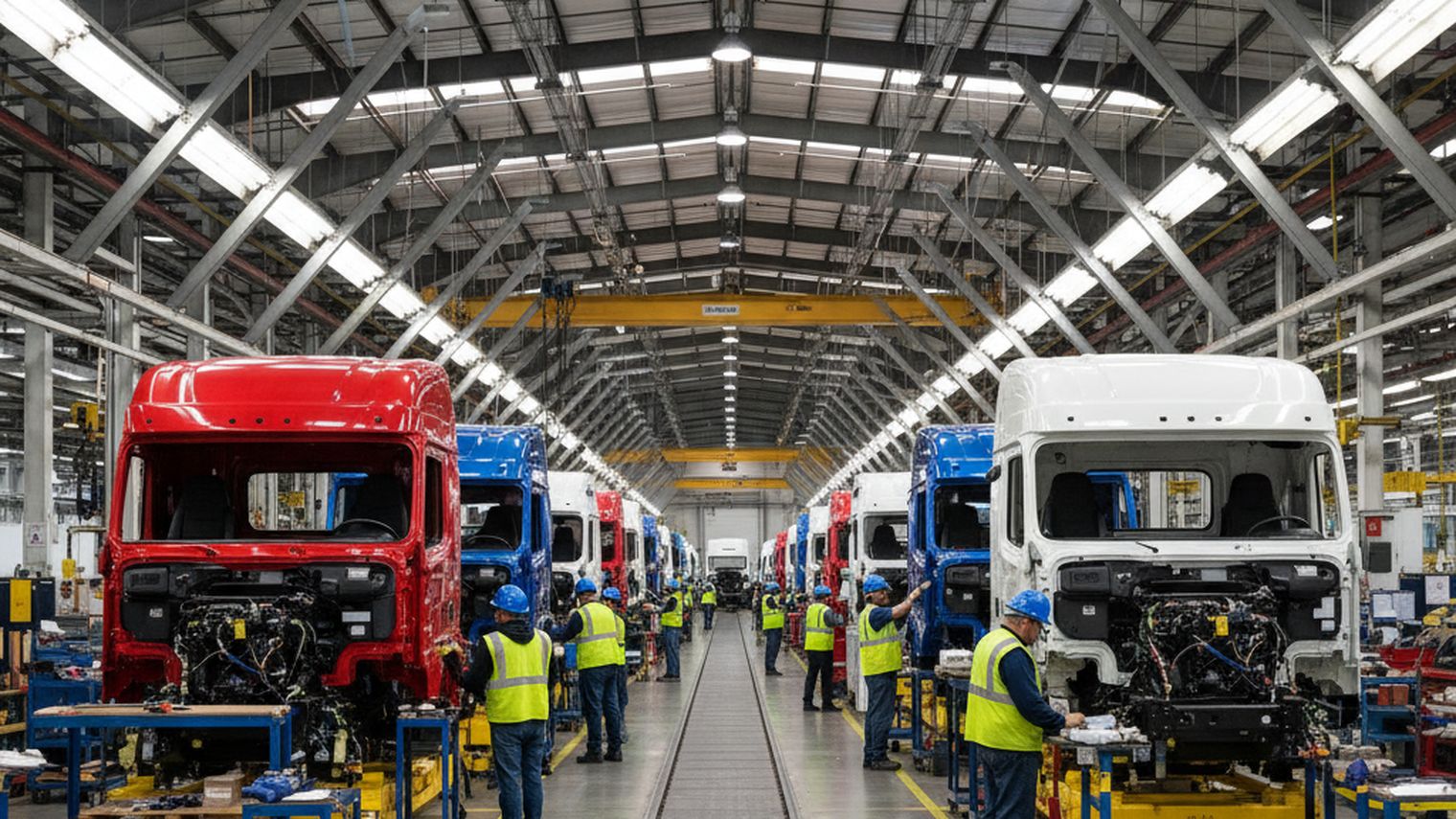
PORTLAND, Ore. — Daimler Truck North America is ending heavy-duty truck assembly in the city where the Freightliner name was built. The company confirmed on July 30 that it will shut the two remaining production lines at its Swan Island plant and move that work to its factories in North and South Carolina, cutting roughly 375 manufacturing jobs and closing out 84 years of truck building in Portland.
The plant has been running since 1969, and in its final configuration it was not a volume Class 8 line. It built the Western Star X-Series vocational trucks and the battery-electric Freightliner eCascadia and eM2 — low-volume, high-mix products that sit awkwardly next to the company's high-throughput Carolina operations. That mismatch is essentially the reason DTNA gave. In a statement reported by the Portland Tribune, the company said the move was intended to "optimize its production network and better align resources with future business needs."
For fleets, the headline is not the layoffs. It is that two product families with real service tails — a severe-duty vocational platform and Daimler's entire North American battery-electric lineup — are changing the building they come out of, midstream.
What Is Actually Moving, and Where It Lands
DTNA is not discontinuing the affected models. It is relocating their assembly into a manufacturing footprint it already owns. The company's own locations listing shows the Carolina footprint it is consolidating into: the Cleveland, N.C., plant, which already builds both Freightliner and Western Star; the Mount Holly, N.C., plant, which handles Freightliner medium-duty; Freightliner Custom Chassis in Gaffney, S.C.; and Thomas Built Buses in High Point, N.C. The Portland Tribune put the count at five truck assembly plants across the two states. DTNA has not published a plant-by-plant breakdown of where each Portland line goes.
Cleveland is the logical home for the Western Star X-Series, since Western Star Class 8 work is already there. Where the battery-electric eCascadia and eM2 land has not been spelled out with the same clarity, and that is the detail worth chasing if you have electric units on order or in a pilot.
Timelines differ slightly across the reporting. Several Portland outlets, including MyNorthwest, place the end of production in October; the Portland Tribune framed it as end of 2026. Either way the wind-down happens inside this calendar year — a short runway for a transfer of this type.
Portland Keeps the Engineering, Loses the Line
This is a manufacturing consolidation, not an exit. DTNA's North American headquarters stays on Swan Island, along with a $40 million engineering facility that opened in July — weeks before the production announcement. "Our commitment to Portland remains strong," the company said, adding that the city will remain "a key center for engineering, innovation, product development, testing, and validation."
A company spokesperson, Robert Sterling, told MyNorthwest the closure was "a network decision," adding that "Portland's production profile is different from our larger plants." DTNA said it would offer severance and transition support, and that some Portland employees may be offered roles at the East Coast factories. The machinists' union was blunter: in a statement quoted by the Portland Tribune, the IAM said the decision "does not remove the heart and soul that our members have put into their work at Daimler."
The practical read for fleets is that engineering, product development and validation authority stay put, so spec definition and service engineering for these trucks should be continuous. Only the build execution changes hands.
What It Means for Fleets Running These Trucks
Line transfers are routine in this industry and rarely clean. Two things tend to slip, and fleets with Western Star vocational units or electric Freightliners on order should plan around both.
Build slots come first. A transfer of this size consumes launch capacity at the receiving plant. If you have a 2027 vocational order in the pipeline, confirm the build window in writing rather than assuming the quoted lead time survives the move. Order-to-delivery on severe-duty configurations is already the least predictable corner of the Class 8 market.
Spec availability is second. High-mix vocational trucks carry long option lists, and not every option travels with the line on day one. Ask your dealer which X-Series configurations are constrained during the transition rather than accepting a general reassurance.
If you already run Western Star or Freightliner equipment, none of this touches the trucks in your yard. Warranty, part numbers and service coverage attach to the vehicle and the OEM, not the building.
The Parts Angle: Build Dates and Plant Codes
The detail that will actually reach the parts counter is a boring one, and it will show up months from now.
Position 11 of a VIN encodes the plant of manufacture. When a model line moves between plants mid-cycle, trucks of the same model year and the same model designation can carry different plant codes. Anyone cataloging by VIN — parts departments, service writers, warranty administrators — should expect that split on Western Star X-Series and electric Freightliner units built across the changeover.
Line transfers also tend to produce running changes: a fastener source, a bracket, a harness routing that differs because the receiving plant tools it differently. These are usually small and usually documented, but they are exactly the changes that make a part look correct in the catalog and wrong on the bench. If you stock for these platforms, treat the transition as a build-date boundary and verify by VIN rather than model year until the pattern settles.
The battery-electric side deserves separate attention. The eCascadia and eM2 have a much smaller installed base and a far thinner independent aftermarket than a diesel Cascadia. Service parts for those platforms run almost entirely through the dealer network, so continuity during the move depends on DTNA's own inventory planning rather than on a competitive supply base absorbing the gap.
The open question is whether this is a one-off. Trade coverage of the announcement framed it as consolidation toward plants and supply chains that have steadily concentrated on the East Coast. If that logic holds it applies to more than one plant, and the parts implications compound. For now the actionable step is narrow: if you have an open order on an X-Series or an electric Freightliner, call your dealer this month and confirm the build plant and build window.

Find the right part for your truck
Tell PartsNow AI the truck and the job. It checks fitment, finds OEM cross-references and pulls live pricing from the catalog.
PartsNow Newsroom
Parts news, straight to your inbox
Product updates, catalog additions and new cross-references. Unsubscribe anytime.