
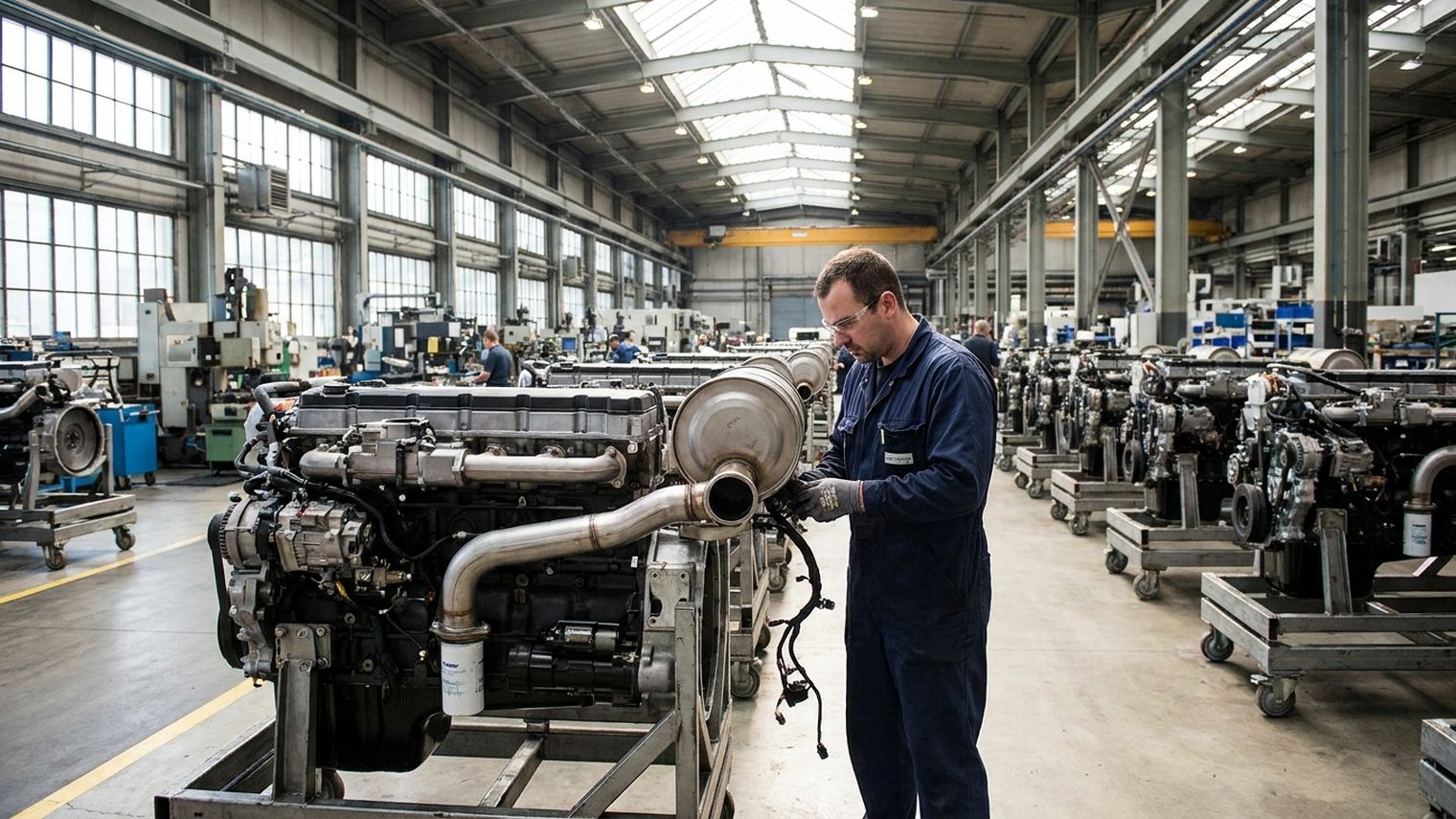
PORTLAND, Ore., Aug. 10, 2026 — Daimler Truck North America is not hedging the EPA 2027 transition. On the company's Aug. 7 second-quarter earnings call, CEO Karin Radström said DTNA will not run parallel engine programs into next year, and CFO Eva Scherer confirmed the company will sell only 2027-compliant engines once the federal low-NOx standard takes effect Jan. 1.
That is a sharper break than the rest of the market is making. Executives at Cummins and Paccar have both said they will keep building 2026-compliant engines after the new regime starts. If you are speccing trucks this fall, the nameplate you choose now decides whether you still have an engine choice in 2027.
A Hard Cutover on the Detroit Side
The standard cuts allowable NOx to 0.035 grams per horsepower-hour from today's 0.2 on the federal test procedure — better than an 80% reduction — starting with model year 2027. Detroit's answer, introduced in February, is the Gen 6 DD13, DD15 and DD16: a pre-SCR catalyst stage placed upstream of the existing one-box, a thermal control valve to bring aftertreatment up to temperature faster, and ratings to 1,900 lb-ft. There is no 48-volt electrically heated element. "We don't need the 48-volt system, which means the incremental cost increase is not that high," Radström said.
DD13 and DD15 arrive in January 2027. The DD16 does not enter production until January 2028 — a real gap for heavy-haul and vocational buyers who spec the big bore. Cummins is going the other way, phasing in the 2027 X15 and X10 at limited volume from January 2027 while keeping the current X15, X12 and L9 in production.
The Warranty Rollback Is the Number to Watch
The regulatory ground is still moving underneath all of this. EPA's proposed amendments to the 2027 rule, open for public comment through Aug. 29, leave the NOx limits alone but roll the emissions warranty back to five years or 100,000 miles instead of the 10-year, 450,000-mile term adopted in the 2023 rule, and defer the longer useful-life periods to model year 2030. EPA puts the effect at up to $6,000 per vehicle.
Read from the maintenance side, that is not a saving so much as a transfer. A first-production-year aftertreatment architecture covered to 100,000 miles instead of 450,000 means years two through five of DPF, SCR and sensor failures land on the fleet's own P&L rather than the OEM's. Cummins has said its product plans and timing could shift if the final rule differs materially from the draft, so neither the warranty math nor the engine lineup is settled yet.
What Parts Buyers Should Do Now
Two practical consequences. First, 2026-spec aftertreatment stays in current production at Cummins and Paccar well into 2027, so those part numbers will not go orphan on the schedule some fleets feared. Freightliner and Western Star buyers get a clean break instead, and mixed fleets will be stocking two aftertreatment generations at once.
Second, skipping 48-volt heating keeps the Detroit change conservative on the shop floor. The one-box stays frame-rail mounted with no back-of-cab repackaging, and DTNA says oil-drain and DPF ash-cleaning intervals are unchanged. The genuinely new content is the upstream pre-SCR stage. Ask your dealer now what that adds to the parts list, how it changes the ash-service procedure, and whether your existing diagnostic tooling covers it. Those answers, not the headline NOx number, are what will show up in cost per mile.

Find the right part for your truck
Tell PartsNow AI the truck and the job. It checks fitment, finds OEM cross-references and pulls live pricing from the catalog.
PartsNow Newsroom
Parts news, straight to your inbox
Product updates, catalog additions and new cross-references. Unsubscribe anytime.