
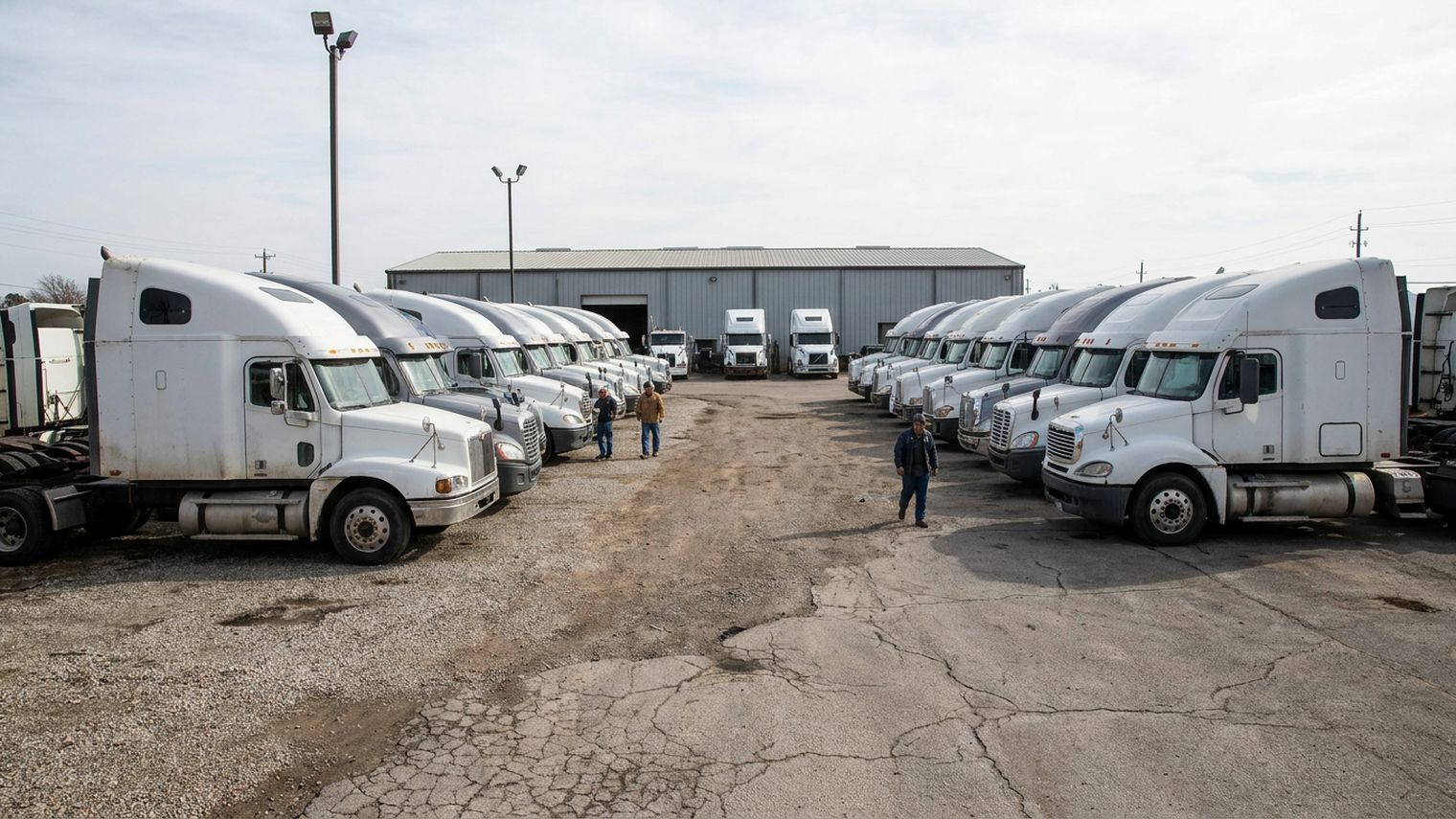
The used Class 8 market cooled in every sales channel last month, and it did so while the trucks themselves were scarcer than they have been in years. Falling volume and falling price against thin supply is not the signature of a glut. It is the signature of buyers stepping back.
ACT Research's preliminary July figures put same-dealer retail sales down 2.9% from June, auction volume down 11% and wholesale down 4.1%, a 5.7% decline across all channels combined. The average retail price of a used Class 8 truck came in at $61,000, down 4.4% on the month, where normal seasonality would have called for a little over 1%.
Thin supply, thinner demand
Steve Tam, vice president at ACT Research, said the sales decline "was larger than expected based on historical seasonality, which called for about a 0.5% m/m decrease," and that pricing softened past seasonal expectations too. His explanation was the freight side: "Considering the spot freight market appears to have hit a ceiling in July, reduced used truck sales are not surprising."
Supply is clearly not the constraint. Sandhills Global's July market report has used heavy-duty inventory down 36.03% year over year and 8.22% month over month, the eighth consecutive monthly drop. Sleepers are tightest of all, off 40.32% from a year ago. Asking values there slipped only 0.88% on the month, which tells you dealers are not the ones cutting.
The replacement decision gets deferred again
When a fleet declines to transact at these levels, the truck it would have replaced stays in service. That moves the cost from a capital line to a maintenance line, and it is the part of ACT's July read that shows up in a shop rather than a boardroom.
A 2019-2021 tractor held back another year is a unit crossing 600,000 to 900,000 miles on its original aftertreatment, air system and driveline. That is the window where DPF and DOC replacement, EGR coolers, turbochargers, air dryer cartridges, wheel seals and steer-tire wear stop being exceptions and become schedule items. The trucks that would have absorbed that mileage on someone else's balance sheet are still on yours.
What fleets should check now
If replacement is off the table for another two or three quarters, budget for it as a parts decision instead. Pull the units past 500,000 miles and price the wear items due in that band before the work orders arrive unplanned.
Two habits save real money here. First, do not treat the dealer number as the only number: running it through a free interchange lookup will surface aftermarket and superseded equivalents before you commit to list price. Second, confirm the model year actually matches, because mid-cycle changes on Cascadia, VNL, T680 and 579 tractors mean a filter or sensor that fits a 2019 build often will not fit a 2021 — the make and model-year specs are worth two minutes before the order goes in.
And if what you have is a symptom rather than a part number — a derate, a slow air build, a coolant loss you cannot place — work it down to a failure mode with the diagnostic guides first. On a truck you have already decided to keep, the expensive mistake is buying the wrong component twice.

Find the right part for your truck
Tell PartsNow AI the truck and the job. It checks fitment, finds OEM cross-references and pulls live pricing from the catalog.
PartsNow Newsroom
Parts news, straight to your inbox
Product updates, catalog additions and new cross-references. Unsubscribe anytime.