
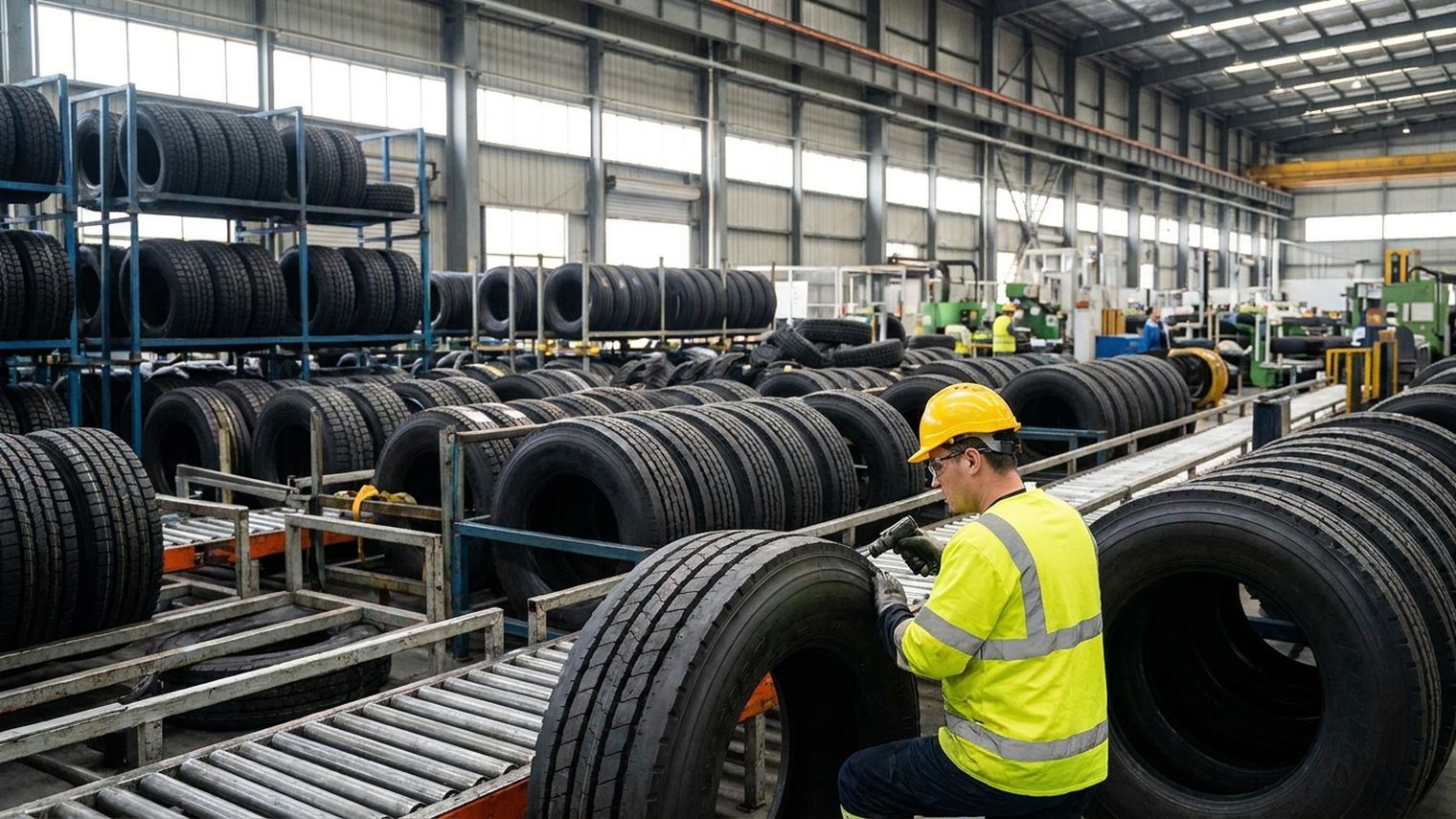
Hankook's first US-built truck and bus radial tires are coming off the line in Clarksville, Tennessee, but the plant is running at roughly 30% of capacity and is not expected to reach full output until the end of 2027.
The timing is the story. A line that will eventually turn out a million commercial tires a year is ramping into a replacement market that is shrinking fast, under a tariff structure that taxes the raw materials going in about as heavily as it taxes the finished imports the plant was built to replace.
Domestic assembly, imported cost base
President and CEO Rob Williams told Transport Topics the company pays "a full 25% tariff for all materials," on top of a 12.5% Section 301 duty on South Korean imports and a 50% levy on steel and aluminum. His read on the net effect was flat: "We don't look at the tariff as an advantage or disadvantage for us."
That is the sentence parts buyers should hold onto. A casing built in Tennessee is not a duty-free casing. Fleets waiting for domestic capacity to pull commercial tire prices back toward 2024 levels should plan on availability improving well before pricing does.
A million tires into a falling market
Demand is moving the other way. The USTMA's July forecast puts 2026 replacement truck tire shipments at 22.9 million units, down 7.1% — 1.7 million fewer tires than last year. Original-equipment truck tires rise 6.2% to 4.6 million, nowhere near enough to cover the gap.
Hankook is building into that anyway. Clarksville currently runs four tread patterns — AL 52, DL 12, DL 52 and DL 21 — with four more due in September, drawn from the fifth-generation Smart lineup that includes the Smart Flex AH51 steer tire and the Smart Line DH51, DH52 and TL52 drive and trailer patterns. By the end of 2027 the company expects 85% to 90% of its US truck tire sales to be built there. It already supplies International's HV and MV series and IC Bus.
What to check before your next tire order
Three things are worth doing this quarter.
If you spec International HV or MV tractors or IC Bus units, the OE tire on a 2027 order may be a domestically built Hankook rather than the import on your last spec sheet — different pattern, different casing source, same position. Confirm what your model year actually ships with before you standardize a replacement size across the yard; the specs and fitment by make and model year are the place to start.
Second, do not read a soft replacement market as license to stretch pull points. A 7.1% drop in shipments partly reflects fleets running casings longer, and that is exactly where irregular wear turns expensive. Scallop, feather and shoulder wear are chassis symptoms, not tire defects — shocks, kingpins, alignment and wheel seals. Work the symptom back to the failing component before you buy another set.
Third, when the teardown names the part, price the interchange before defaulting to OE. Steering and suspension components on Class 8 tractors carry wide aftermarket coverage, and a cross-reference on that part number will usually surface two or three qualified alternates — worth the two minutes in a year when duty is stacked on nearly everything with steel in it.

Find the right part for your truck
Tell PartsNow AI the truck and the job. It checks fitment, finds OEM cross-references and pulls live pricing from the catalog.
PartsNow Newsroom
Parts news, straight to your inbox
Product updates, catalog additions and new cross-references. Unsubscribe anytime.