
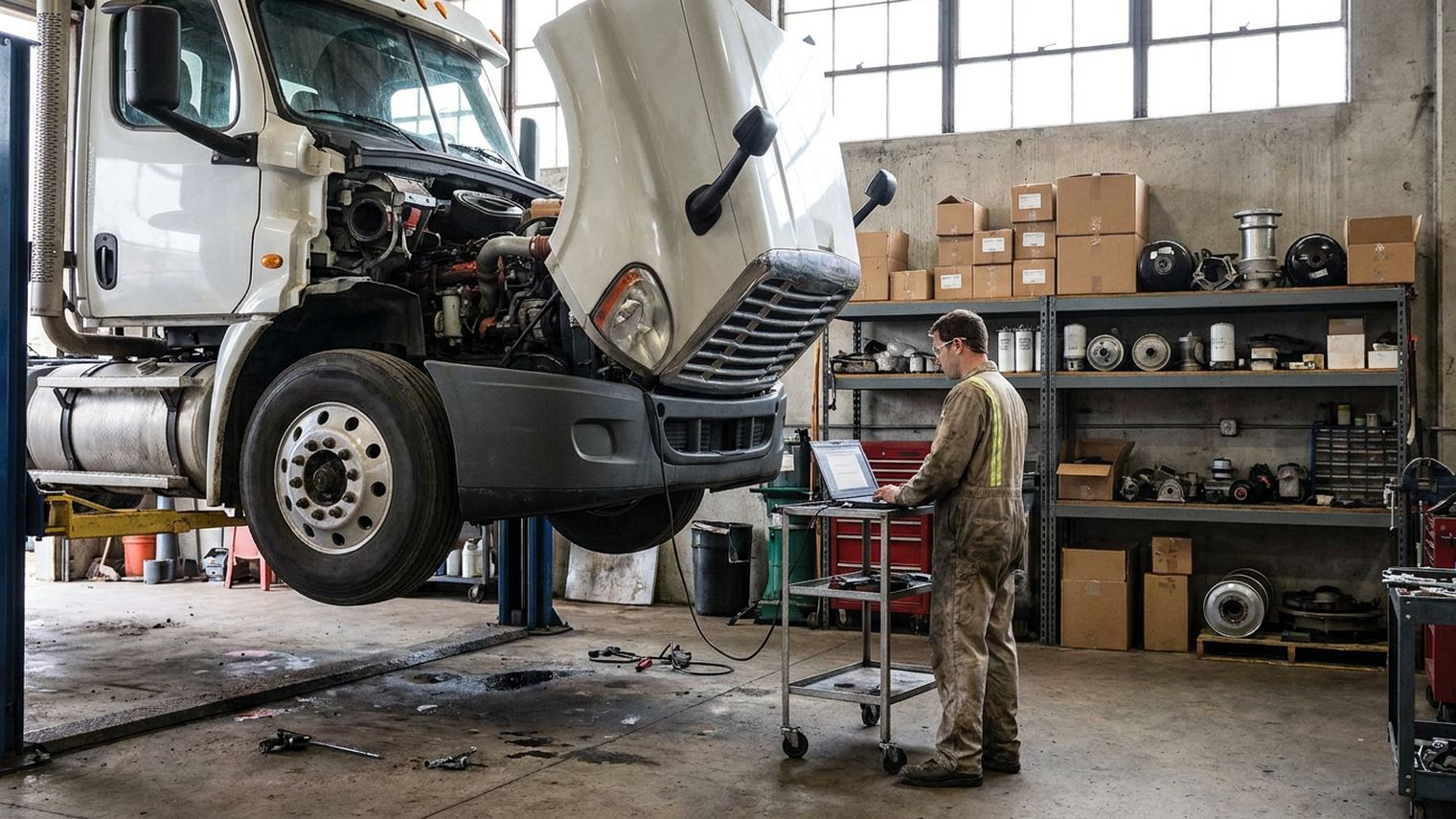
PITTSBURGH — The most useful thing said about artificial intelligence at this year's fall gathering of truck maintenance managers was an admission of failure. Cummins worked with a third party for roughly two years on an AI tool meant to help spec trucks, then shelved it because the recommendations were not consistently good enough.
That came from the same run of panels where fleet and dealer executives made the case for AI compressing a repair estimate from two hours down to actual wrench time. Both are real, and the gap between them is where fleets will spend money this year.
The two-hour clock
The framing device at The AI Summit, held alongside the American Trucking Associations' Technology & Maintenance Council Fall Meeting on Sept. 23, was TMC Recommended Practice 1604 — the benchmark for rapid repair assessment, which sets a two-hour target from vehicle arrival to an approved estimate. Panelists walked it through using a fictional technician, Alex, who must log the unit, diagnose the complaint, check parts availability and get authorization before touching a wrench.
Matt Johnston of Design Interactive argued the sequence itself is the problem: “We have to do things serially, and a computer will do that in parallel.” Mark Kennedy, vice president of equipment at Knight-Swift and TMC's general chairman, described the version fleets actually want — a truck reporting a fault from the road, a system that reserves a bay and sources the parts, and a likely repair plan already waiting. “I think that'll take those two hours and shrink it down to actual repair time,” he said.
Confident, and sometimes wrong
The same panelists were blunt about the limit. “If your data isn't good, Alex is going to be going down a bunch of different rabbit holes,” Kennedy said. Rocco Marrari of Pedigree Technologies put a number on how far real-time anomaly detection gets a shop today: “We have enough data to get you about 70% there.”
Cummins' Kristopher Ptasznik described what the rest costs. The spec tool he shelved had confidently recommended a higher road speed for a heavy-haul fleet because its data did not distinguish that operation from linehaul. “AI, when it doesn't have those data points to pull in, it's not making a good decision. But it's always confident in its decision,” he said. Randy Bell of International Motors made the point from the configuration side: “a buildable configuration isn't necessarily the best configuration,” and the future “isn't AI spec'ing trucks. It's AI helping fleets and their OEM partners spec trucks better.”
What to check before the parts order goes out
Seventy percent is the number worth holding onto, because the missing share is the expensive part — the component you actually buy. Treat an AI or telematics suggestion the way you already treat a fault code: a pointer to a system, not a verdict on a failed component. An SCR or DEF dosing fault, a NOx sensor code, a DPF differential-pressure complaint — each names a circuit with several candidate failures behind it, from a plugged dosing injector to chafed harness wiring.
Two habits keep a 70% guess from becoming a 100% invoice. When what you actually have is a symptom, work it backward through a diagnostic guide for that failure mode before committing to a part. And when a number comes back — from a shop system, a dealer counter or a prediction — verify the interchange for that part number before the order leaves, because supersessions and cross-brand equivalents are exactly the data that goes stale inside these tools.
On the spec desk the same rule applies to the truck: confirm what a given make and model year actually takes before a retrofit or a standardization call. AI is fastest at the part of the job that was never the bottleneck — whether the number on the invoice fits the truck on the lift.

Find the right part for your truck
Tell PartsNow AI the truck and the job. It checks fitment, finds OEM cross-references and pulls live pricing from the catalog.
PartsNow Newsroom
Parts news, straight to your inbox
Product updates, catalog additions and new cross-references. Unsubscribe anytime.